-Bourriaud states that because of this eradication the original material that is manipulated is no longer primary, does this thought then directly add relevance to Walter Benjamin's' perceived loss of aura?
However Bourriaud's last sentence of POSTPRODUCTION is:
"Because art is an activity that produces relationships to the world and in one form or another makes its relationships to space and time material." pg.94
Is it really not that Altermodernism has distinguished the aura of an object, but has redefined an art works' positioning of time and space, the aura is now manifested not as a specific object 'but as mediums of experience . . . art restores the world to us as an experience to be lived.' pg.32?
Bourriaud states, " To use an object is necessarily to interpret it, To use a product is to betray its concept". What does he mean by this? To clean a toilet with a toilet brush, is to betray its function? Or is that by employing an object in its designated utility, it idea or concept is negated? This seems very obtuse to me.
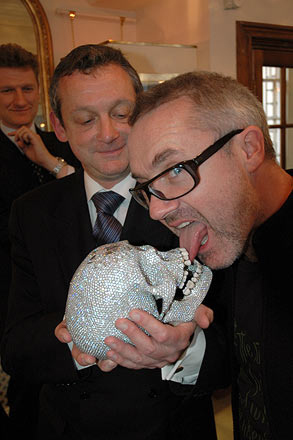
I understand and appreciate the concept of artists and 'viewers' as tenants of culture. However were does craft fit into this world where the emphasis is put on an artists gaze and not their craft; where the aesthetic is that of flea-market and displacement of history and references, to create a new symbology? Where is the line drawn, can craft and the skill-set that comes with it coexist in the arena of flea market and the artists gaze? I make jewelry, its function is innately to be worn and to adorn, because of it's function does it relate back to Judd's comment that a chair can't be sculpture because it can't been seen when sat in?
-Though seen from another facet, Bourriaud seems to be arguing that the high and low arena's are changing focus and importance. That 'low' art, which is an 'exaltation of outer limits, bad taste and transgression', has a new elevated meaning; low and high have switched places. On that strain, one could argue that metals, always stationed in the outer limits may finally be able to participate in the larger conversation. Maybe. Bourriaud talks of eclectic taste on page 89 and he says the it enables us to find a personal identity, that taste lets us identify by personal strategy of sign consumption. As adornment, jewelry is one of societies most well-known and visual signifiers of class, status, political sway, and 'taste', in this manner Metals succeeds.